
By Henry Kinyua
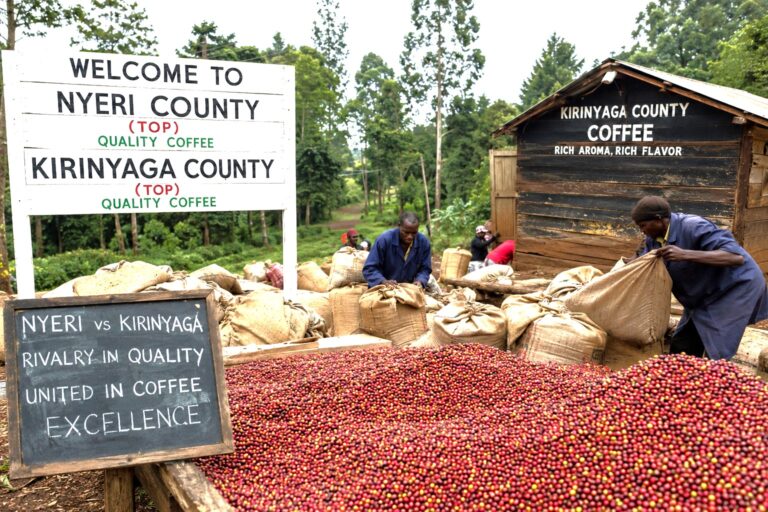
If there is one county that continues to demonstrate the strength of Kenya’s cooperative coffee model, it is Kirinyaga County. With 14 Farmers Cooperative Societies (FCSs) operating through 74 affiliated factories, the county remains one of Kenya’s leading coffee producers and a benchmark for cooperative success.
Over the last three seasons, Kirinyaga’s cherry production has grown steadily from 42.28 million kilograms in 2023/24 to 45.72 million kilograms in 2024/25, reaching 49.10 million kilograms in the ongoing 2025/26 season. This represents an impressive 16.1 % growth in just two years, equivalent to an additional 6.8 million kilograms of cherry production.
The growth story, however, varies across cooperatives. Among the standout performers is Rwama FCS, which recorded the fastest growth in the county, expanding by an impressive 360 % over the period. Ngiriambu FCS also posted strong gains at 85%, while Karithathi, Inoi, and Rung’eto cooperatives registered solid growth, reinforcing Kirinyaga’s reputation for resilience and strong farmer participation.
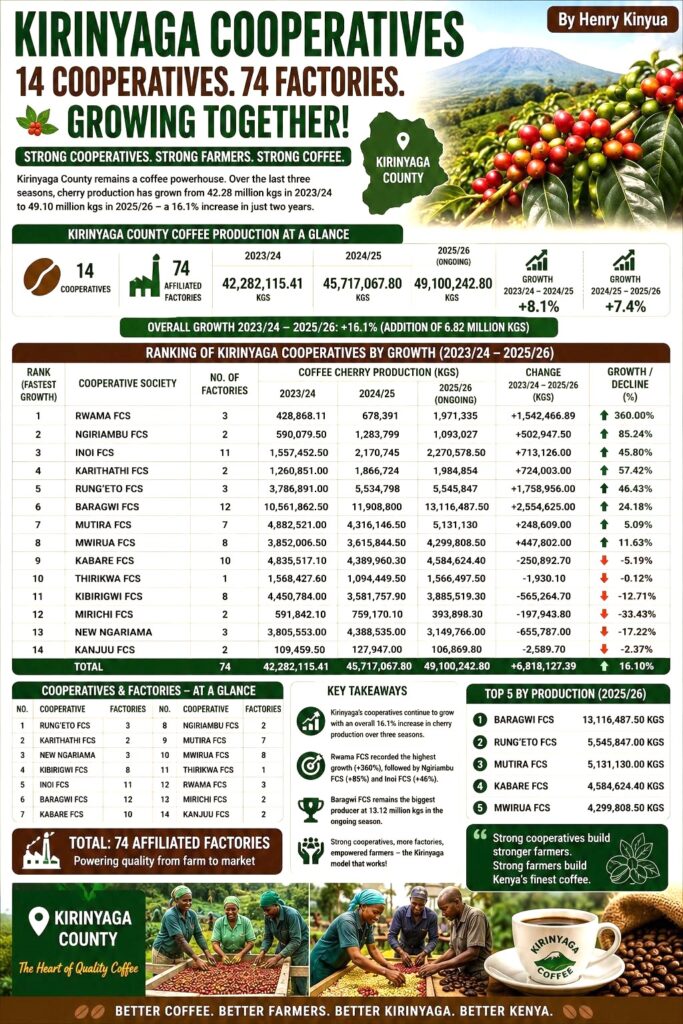
Even as smaller cooperatives record notable percentage gains, the county’s largest volumes continue to come from long-established institutions. Baragwi FCS, operating through 12 factories, remains Kirinyaga’s biggest cooperative, projected to deliver over 13.1 million kilograms of cherry this season, a volume larger than what some counties produce in total. Other major players include Rung’eto, Mutira, Kabare, Mwirua, and Kibirigwi, all of which continue to anchor the county’s production.
Not every cooperative is expanding, however. Some societies, including Mirichi, New Ngariama, and Kibirigwi, recorded declines over the period. What makes Kirinyaga unique is not just its production volumes but also the institutional structure that supports farmers. The county’s cooperatives aggregate through the Kirinyaga Union, giving growers access to farmer-owned milling, brokerage, Kirinyaga Slopes, and direct sales agency. At a time when many regions struggle with fragmentation and weakened institutions, Kirinyaga has largely managed to address governance challenges without breaking up cooperatives.
The outcome is clear: more coffee, stronger institutions, and some of the highest farmer payments in Kenya.
As the county continues to grow, one question remains: which cooperative will lead Kirinyaga’s next phase of expansion? Are you from Kirinyaga? Which is your cooperative?