
By Henry Kinyua
When Kenyans talk about premium coffee, three counties almost always dominate the conversation: Nyeri, Murang’a, and Kiambu.
These are the heavy hitters of Kenya’s coffee story and the home to large estates, powerful farmer cooperatives, deep coffee culture and some of the country’s most aromatic and sought-after beans. For decades, buyers chasing Kenya’s signature bright acidity, floral aroma and rich cup profile have looked toward these counties.
But how are the three giants performing in the ongoing 2025/2026 coffee season, compared to the full 2024/2025 season?
The numbers reveal a fascinating story of shifting fortunes, changing quality patterns, and a fierce race for coffee supremacy.
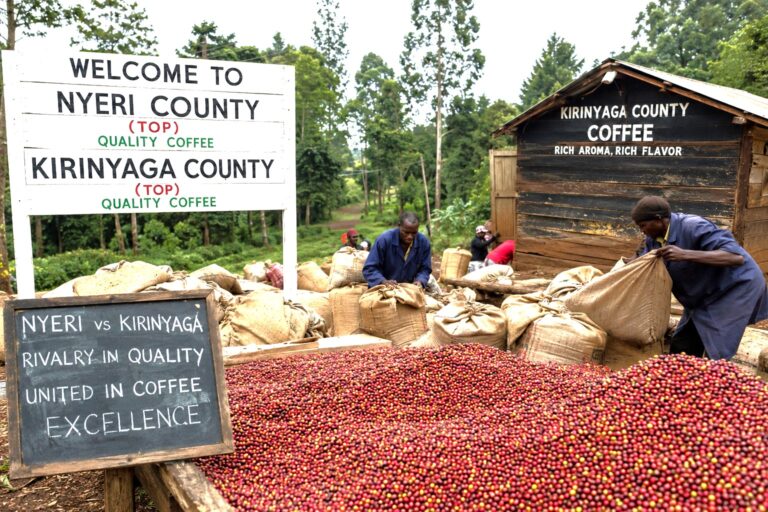
Nyeri, long regarded by many as Kenya’s premium coffee capital, continues to lead on quality. Even with only 29 sales completed this season compared to 42 last year, the county has already traded 4.08 million kilograms of coffee, generating KSh 3.71 billion at the Nairobi Coffee Exchange. While this remains below last season’s 5.46 million kilograms valued at KSh 4.87 billion, Nyeri’s quality profile has strengthened significantly.
The county’s prized AA grade jumped from 26 percent to 34 percent, while the lower-priced C grade dropped sharply from 10 percent to only 5 percent. Although AB grade reduced slightly from 39 percent to 37 percent, the stronger AA performance helped push average auction prices from USD 345 to USD 352 per 50kg bag. This translates to an estimated gross cherry equivalent improving from KSh 137 to KSh 140 per kilogram, or about KSh 112 after a standard 20 percent deduction, representing a modest but important 2 percent increase in returns.
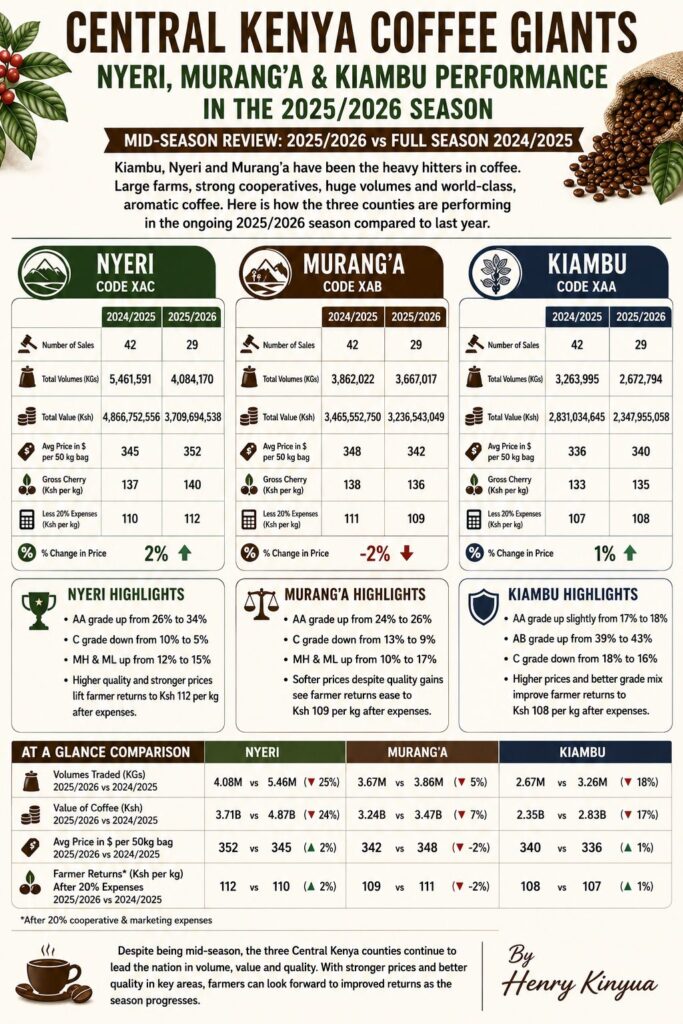
Murang’a, meanwhile, appears to be having a mixed season. The county has already marketed 3.67 million kilograms worth KSh 3.24 billion, slightly below last season’s 3.86 million kilograms valued at KSh 3.47 billion. While quality has improved modestly, with AA rising from 24 percent to 26 percent and C grade declining from 13 percent to 9 percent , prices have softened slightly.
Murang’a’s average auction price dropped from USD 348 to USD 342 per 50kg bag, translating to estimated farmer equivalent returns slipping from KSh 111 to KSh 109 per kilogram after deductions, a 2 percent decline. The rise in MH and ML Mbuni from 10 percent to 17 percent may partly explain the softer average prices despite improvements in premium grades.
Kiambu, Kenya’s traditional estate powerhouse, remains steady and resilient. Though often overshadowed by Nyeri’s quality reputation and Murang’a’s cooperative dominance, Kiambu continues to post solid numbers. The county has traded 2.67 million kilograms valued at KSh 2.35 billion so far this season, compared to 3.26 million kilograms worth KSh 2.83 billion last season.
Kiambu’s quality mix shows slow but steady improvement. AA grade rose slightly from 17 percent to 18 percent, while AB improved from 39 percent to 43 percent, making it the county’s dominant grade. Lower-valued C grade declined from 18 percent to 16 percent, while PB eased slightly from 6 percent to 5 percent.
The market has rewarded this consistency. Kiambu’s average auction price improved from USD 336 to USD 340 per 50kg bag, translating to gross cherry equivalent improving from KSh 133 to KSh 135 per kilogram, or around KSh 108 after deductions, a 1 percent improvement.
Looking at the three side by side, Nyeri remains the king of premium quality, driven by its rising AA share and highest average prices. Murang’a continues to dominate through scale and cooperative strength, though it faces pressure to maintain prices. Kiambu, meanwhile, remains quietly dependable, less dramatic, but consistently competitive.
Yet perhaps the most important story is that despite only being midway through the season, all three counties have already traded billions of shillings worth of coffee. And with several cooperatives now announcing cherry payments of over KSh 140 to KSh 150 per kilogram, Central Kenya’s coffee belt is once again proving why it remains the heartbeat of Kenya’s coffee economy.
In coffee, quality pays. And in Nyeri, Murang’a and Kiambu, the race to produce the best cup is still very much alive.