
By Henry Kinyua
The Nairobi Coffee Exchange (NCE) held its final auction before the mid-year recess on Tuesday, with Sale 29 recording strong activity as buyers moved to secure stocks before trading resumes in July.
The sale traded 14,284 bags, equivalent to 884,714 kilograms of clean coffee, generating a total market value of approximately USD 4.65 million (about KSh 599 million. The auction settled at an average price of USD 262.52 per 50kg bag, while the highest price of the day reached USD 391 per 50kg bag for AA grade coffee.
Grade distribution reflected the broad quality mix currently entering the market as the main crop season comes to an end. AB accounted for 21.4% of the total volume, followed by MH Mbuni at 26.3%, while AA contributed 11.8%. Other important grades included ML, PB and C, showing continued demand across both premium and commercial coffee categories.
On the buying side, Sasini (K) Limited emerged as the largest dealer after purchasing 3,130 bags, representing 21.9% of total volume. It was followed by Louis Dreyfus Company (17.9%), Ibero Kenya Ltd (13.9%), Taylor Winch Coffee Ltd (13.4%), and Global Mark Foods Ltd (7.2%). Together, the top five buyers controlled nearly three-quarters of the auction.
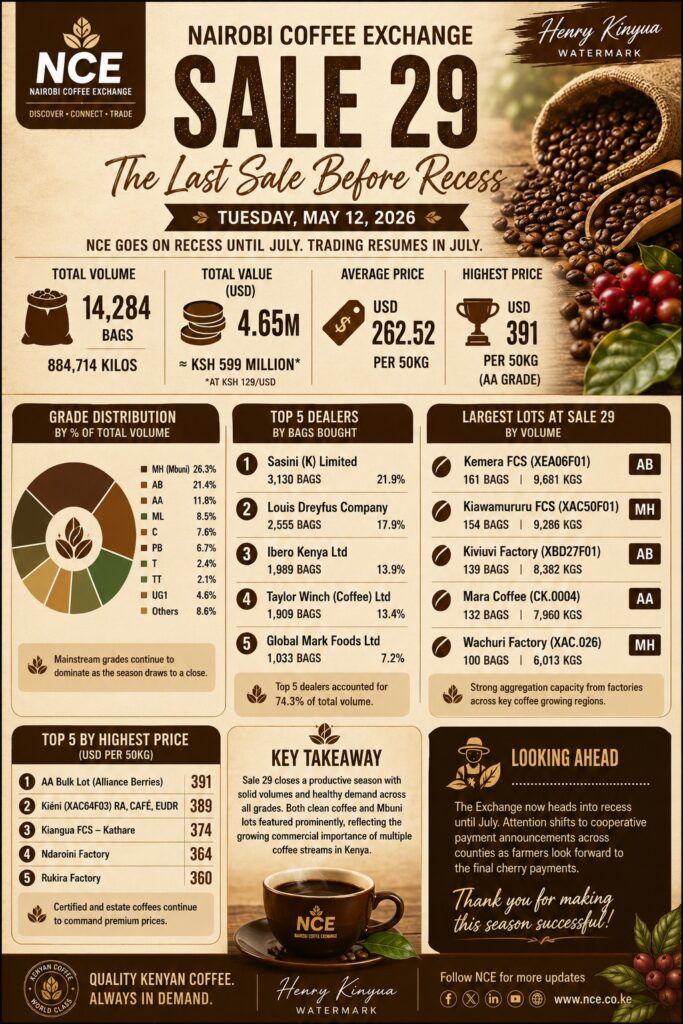
Sale 29 also featured several exceptionally large lots from factories and estates, highlighting strong aggregation capacity in some producing regions. The largest lot came from Kemera FCS in Nyamira County, which presented 161 bags of AB coffee weighing 9,681 kilograms. Kiawamururu FCS in Nyeri County followed closely with a large MH Mbuni lot of 154 bags weighing 9,286 kilograms, while Kiviuvi Factory from Embu delivered a 139-bag AB lot weighing 8,382 kilograms. In the premium segment, Mara Coffee presented a substantial AA lot of 132 bags weighing 7,960 kilograms. At the same time, Wachuri Factory from Nyeri county also stood out with a 100-bag MH Mbuni lot weighing 6,013 kilograms.
As the exchange now heads into recess until July, attention shifts to cooperative payment announcements across coffee-growing counties, with farmers keen to see how auction prices translate into final cherry payments. Despite softer prices compared to the early season highs, Sale 29 once again confirmed sustained international demand for Kenyan coffee.