
By Henry Kinyua
The cost of producing coffee in Kenya remains a critical concern for farmers. The data from the 2023/2024 Agriculture and Food Authority (AFA) Coffee Directorate Yearbook shows that while costs vary across varieties and management levels, profitability ultimately depends on one key factor: productivity per tree.
According to AFA analysis, the cost of producing 1 kilogram of cherries ranges from KES 31 to KES 48. Improved varieties such as Ruiru 11 and Batian perform better under high management, with costs averaging KES 31 per Kg, while farmers at average management levels incur KES 36–39 per Kg. Traditional varieties (SL28, SL34, and K7), which are more input-intensive, record higher costs of KES 39–48 per Kg, particularly where yields are low.
While these figures are based on the 2023/2024 production season, it is important to note that input and labour costs have likely increased since then. However, the underlying economic principle remains unchanged: productivity is the single biggest determinant of cost per kilogram.
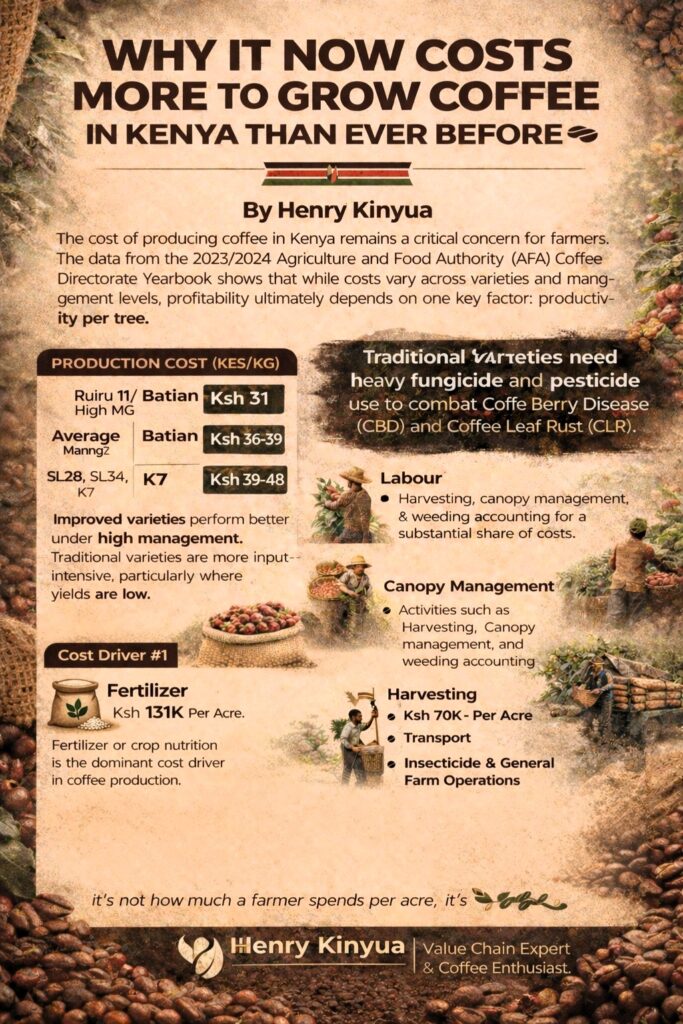
Fertilizer or crop nutrition is the dominant cost driver in coffee production. Under high management systems, fertilizer application alone can exceed KES 131,000 per acre, making it the largest single expense on the farm. Labour associated with the application further increases this cost. Agrochemicals, particularly fungicides, also play a significant role, especially for traditional varieties that are susceptible to Coffee Berry Disease (CBD) and Coffee Leaf Rust (CLR).
Farmers growing these varieties must invest heavily in disease control, raising overall production costs compared to disease-resistant varieties like Ruiru 11 and Batian.
Coffee farming remains labour-intensive, with activities such as harvesting, canopy management, and weeding accounting for a substantial share of costs. Harvesting alone can cost over KES 70,000 per acre under high production systems, reflecting the manual nature of cherry picking in Kenya. Additional costs, including insecticide application, transport, and general farm operations, further increase the financial burden on farmers.
Farmers also incur downstream costs through cooperative societies. Processing and administrative charges average about KES 14.8 per Kg, reducing the farmer’s net return. These costs, though often overlooked, are high when combined with on-farm production expenses.
The most important takeaway from the AFA data is that low productivity leads to higher cost per kilogram. Farmers producing 10 Kg of cherry per tree are able to spread their costs efficiently, achieving lower unit costs. In contrast, those producing 5 Kg or as low as 2 Kg per tree, who are the majority, face significantly higher costs per kilogram, even when their total expenditure per acre is lower.
In simple terms, it is not how much a farmer spends per acre that determines profitability; it is how much they produce per tree. What is your current production per tree?