
By Kimuri Mwangi
The false codling moth (FCM) has emerged as one of the most serious threats facing Kenya’s floriculture and horticulture exports, with the pest classified as a quarantine organism under European Union (EU) phytosanitary regulations. A single larva detected in a shipment can trigger the rejection of an entire consignment, exposing exporters to heavy financial losses and putting access to key international markets at risk.
Flower exporters describe the pest as a persistent and significant issue, noting that it attacks more than 50 crops, including roses, citrus, avocados, capsicum, maize, cotton, mangoes and macadamia nuts. Its ability to cause widespread damage, combined with zero-tolerance regulations in Europe, has intensified pressure across the value chain.
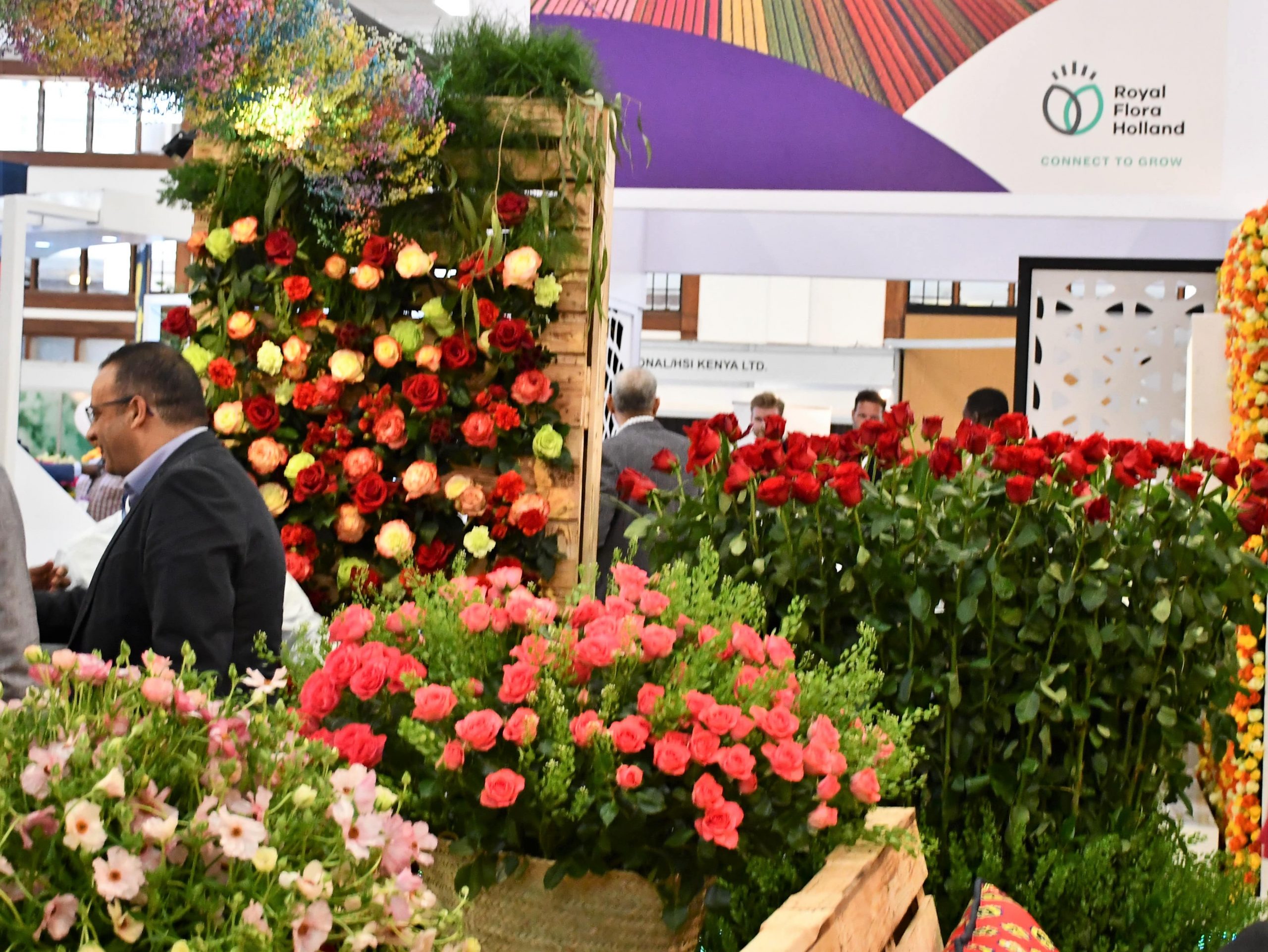
According to the Kenya Flower Council (KFC), FCM was declared a quarantine pest on roses in 2018, prompting heightened scrutiny of Kenyan exports. “By 2018, FCM on roses was declared a quarantine pest, and therefore, for Kenya, which controls close to 40 percent of all the exports in Europe, this became very paramount for us to start complying with all the rules and regulations that were coming into the market,” said KFC Chief Executive Officer Clement Tulezi.

Data compiled since then show persistent interceptions, ranging between 21 and 40 annually, a level the EU considered high. In response, Kenya adopted a systems approach protocol developed jointly by the industry and government agencies, including the Kenya Plant Health Inspectorate Service (KEPHIS). Tulezi said the protocol was submitted to the EU by the April 26, 2025, deadline and has already shown results.
“So, for us, it’s about how we can implement it and show that it works, and that it can mitigate every risk that comes with the occurrence of being able to export literally on our flowers. We have seen that it works, because if we look at the data that has come out, since we started implementing this on the 26th April 2025, we have only had four interceptions, at least until today. It shows it works, but the audit that was done by the EU about a month ago has shown that we still have certain gaps that we need to fill, and therefore, we still have a lot of work that needs to be done. Of course, the other thing that we did was to ensure that all the sites have been registered to continue exporting to the EU,” opined Tulezi.
The economic stakes are substantial. Data from KEPHIS shows that the floriculture sector employs more than 200,000 people and is a major source of foreign exchange. In 2024, Kenya exported over 102,500 tonnes of fresh cut flowers valued at €507.7 million, much of it destined for the EU. Increased border checks, rising from 10 percent in 2020 to 25 percent in 2024, have added to costs, while reputation risks threaten long-term market access.
Experts warn that the biology of the pest makes it especially dangerous if left unchecked. “The most dangerous, if not controlled, is the adult stage because it’s where the mating is happening,” said Dr Vernon Steyn, an entomologist and FCM specialist at Insect Science in South Africa. Each female can lay an average of 130 eggs, allowing populations to explode from a single moth to millions within weeks. The larvae then burrow into flowers or fruit, where they are shielded from contact pesticides.
To counter this, stakeholders are increasingly turning to integrated and biological control methods. Kenya Biologics Ltd, a biotechnology company producing bio-pesticides and bio-control products, convened two conferences in Thika and Naivasha where growers, exporters, scientists and regulators engaged to promote a coordinated response. Managing Director Martin Montbarbon said the aim was to move away from fragmented efforts. “We share a common challenge, a common pest, so today we’ve tried to bring together key stakeholders to talk about that challenge,” he said. Montbarbon noted that reliance on synthetic chemicals is becoming less viable due to regulatory bans and residue concerns.

“So that’s why we had to seek help and advice where the expertise was, and it appears that South Africa has been facing and controlling FCM for a long time already. So, we’ve developed a partnership with a company called Insect Science. Since we started using this solution, we have really focused on the adult stage of the pest with mating disruption solutions, and we have been able to really drop the trends of the FCM. And in the flower industry, for instance, we have growers that get as high as 12-15 catches per week on a single pheromone trap. And with the use of those solutions, we’ve been able to record as low as zero moth, sometimes one moth. We have made tremendous achievements in that regard. Synthetic products are reducing over time. Before, you could spray a lot of molecules. Nowadays, those molecules are less and less available, especially the systemic ones. Systemic molecules are within the plants, and they are also eventually found on your plate. That’s why they are being banned slowly. So, we are left with fewer chemicals, and most of them are contact chemicals. When you deal with a pest like FCM, it’s very difficult to achieve contact because as soon as the egg hatches, it goes and digs inside the fruit or the flower, and it hides, making most contacts non-relevant. So, the advantage of the biologicals is that we can disrupt their communication at the adult stage and prevent the mating, which is what can really help break the cycle,” he added.
Dr Steyn emphasized that effective control requires interventions at every stage of the moth’s life cycle, from eggs and larvae to adults, combined with rigorous monitoring and inspection before export.
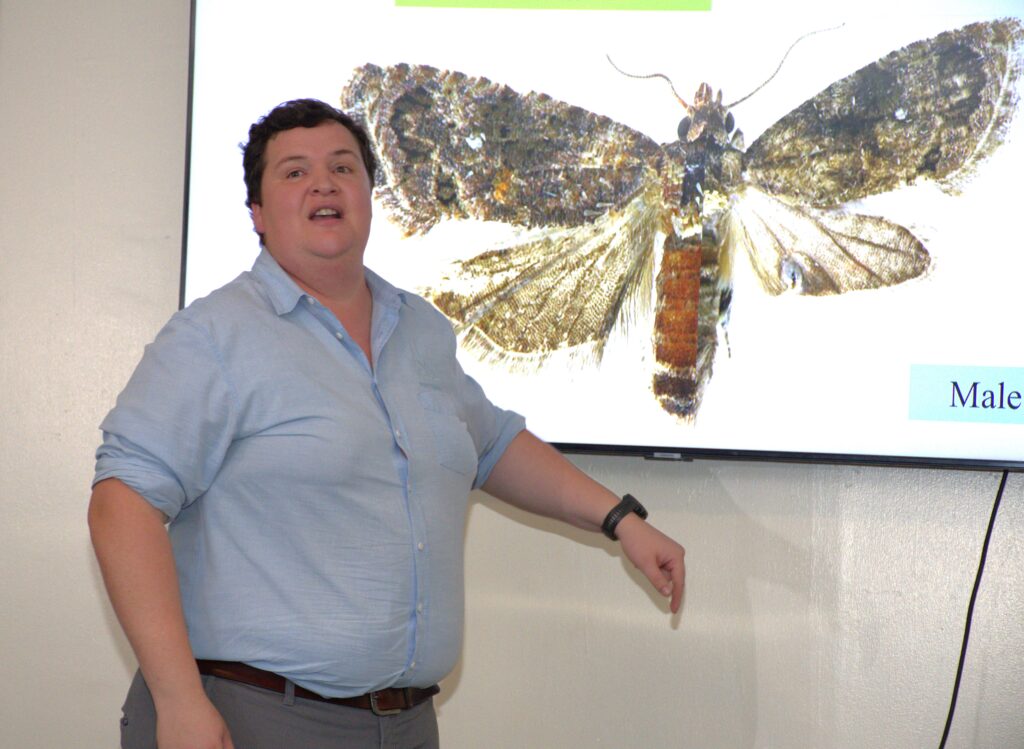
“For any pest, one has to look at the life cycle. You know that the female has to mate with a male to cause a fertile egg, then the egg becomes a larva, and the larva becomes a pupa. The larvae is the one that’s creating the damage. It’s very important to have a control strategy at each stage. For the larvae and the egg stage, it’s nice to use parasitoids, viruses, bacteria, and even in some cases, you can use insecticides. For the adult stage, it’s good to use mating disruption or attract and kill, so one has control at each stage of the life cycle. Then one can use a monitoring trap to monitor on your farm, where the pests are and when they are there. Once you have that information, you can then use one of these control techniques to put into the system. This is all part of the pre-harvest systems approach, where you monitor, then you do control. But then you must also do an inspection of your roses or avocados before they get exported, because that’s another stage where you can pick up FCM. If there’s a larva on the rose, you can just throw it away. Just that one rose, you throw away. Just have as many checks as you can before you export. Because if you get a larva when you export, they don’t just throw away the one rose; they throw away that whole consignment of roses. You have to ensure that at each stage on the farm and after you’re off the farm, there’s an inspection at the harbour. At each stage, you are trying to take individuals out. You start with a lot, and it becomes less and less. Then by the end, there’s no FCM left, and you can export FCM-free crops to Europe,” explained Dr Steyn.
However, challenges remain, particularly among smallholder farmers who account for about 80 percent of Kenya’s agricultural production. High upfront costs, limited access to products and knowledge gaps hinder the adoption of preventive biological measures, which often need to be applied months before harvest. Montbarbon said this imbalance has led to faster uptake in export-oriented farms than in crops for local consumption.
South African experience suggests that strict compliance and collaboration are critical. Martin van Niekerk, Technical Director at Science Africa, said as long as you are sticking to the protocol and you’re doing all the things necessary, FCM is not a problem to control, adding that non-compliance risks entire national industries.

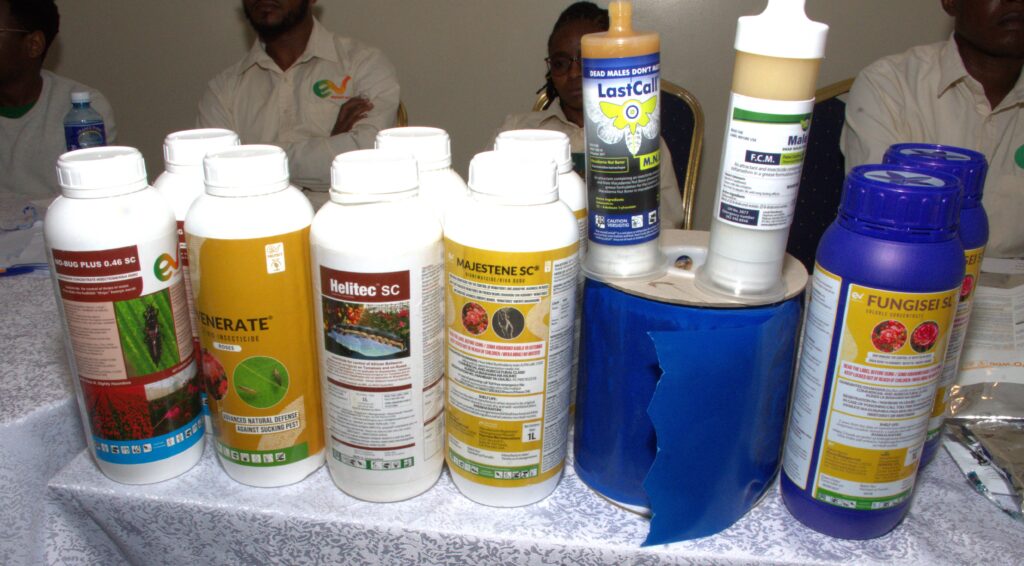
Some of the biological products available in the market. Photo by Kimuri Mwangi
“We have very good institutions that have designed the systems approach on the different protocols and methods to control FCM. And it’s a very strict protocol. And as long as you are sticking to the protocol and you’re doing all the things necessary, FCM is not a problem to control. When it comes to compliance, you don’t have a choice. That’s one of the success stories in South Africa that we have in controlling FCM. The regulators and the boards in place in South Africa are very strict on how compliant you are with controlling FCM. And if you are not compliant, you do not export your fruit because you put everybody else in your country at risk. It’s the same here in Kenya. Everybody should be very strict on how compliant they are with the systems that KEPHIS and KFC, and everybody else put in place, and they are good strategies. If everybody applies their mind and applies their best control to their protocols, FCM will be controllable, and you will have less risk to each other and the whole of Kenya’s flowers,” opined Niekerk.
According to KEPHIS, Kenya’s systems approach integrates greenhouse integrity, pheromone trapping, scouting, targeted pesticide use, sanitation, and multiple inspection points from harvest to exit. Dr Mary Guantai of KEPHIS described the approach as combining pre- and post-harvest measures to meet importing countries’ phytosanitary standards.
Industry leaders remain cautiously optimistic. Tulezi said declining interception numbers show progress but stressed that zero tolerance remains the benchmark, calling for intensified knowledge sharing, innovation and the addition of biological controls as an extra layer of protection.
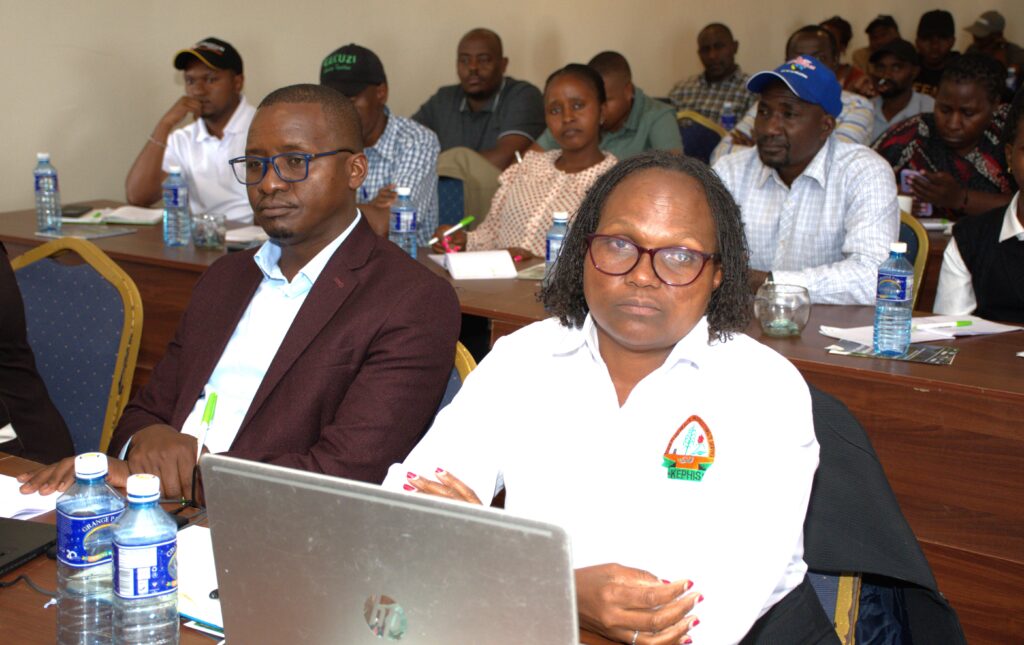
“We believe that we have other controls that have been put in place because of the systems approach protocol that we have, but we’re also looking at the possibility of having biological controls and that is why we need to have another layer as we are looking at much more mechanical, chemical and other ways in which we control this across the entire supply chain. We add another layer of biologicals. Biologicals come from products that have been created out of organic matter or much more natural and when we look at the use of chemicals and the debate that is ongoing around pesticides, around fungicides, around all these chemicals, we see biologicals as an alternative to this and therefore if it comes in and we have a proper understanding of how they can be used to control FCM, I think we’ll be in a better place. We’re also giving choices and options to the growers and exporters, and I live in a world where people need options. Whatever works for them and is effective and allowed, I think people need options so that we are not just looking at one and saying this is the only one. When people have options, and they can use as many as possible, it allows us to mitigate the current challenge as much as possible,” he concluded.
As export markets tighten regulations and competition intensifies, Kenya’s ability to contain the false codling moth through coordinated action, science-based protocols and wider adoption of biological solutions may determine the future of one of its most valuable agricultural industries.