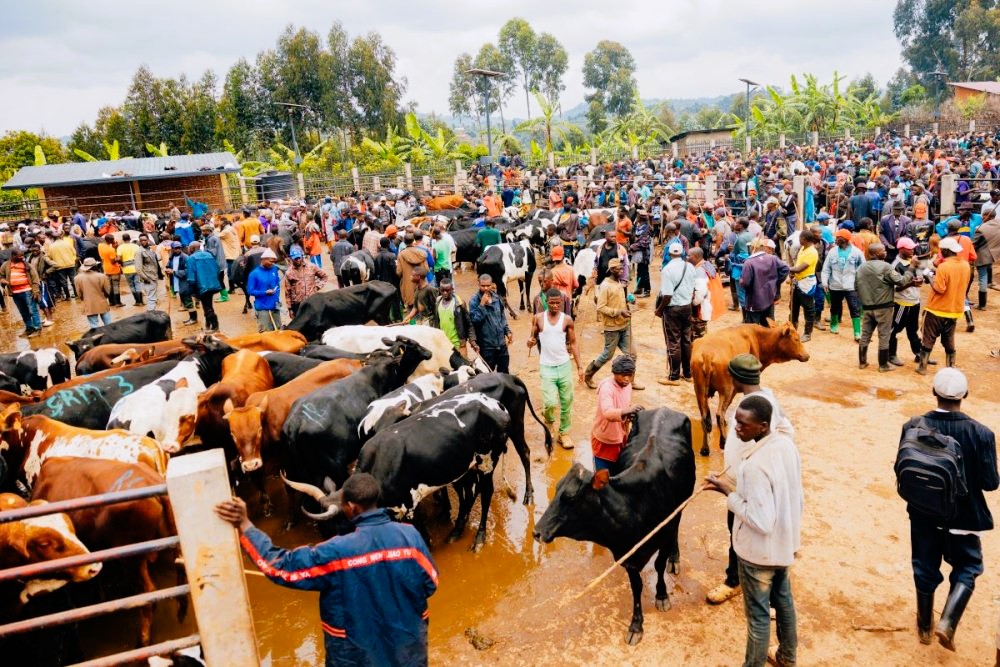
The Ryarubondo livestock market in Nyamagabe District of Rwanda has grown into a sub-regional trading hub following its renovation at a cost of more than 426 million Rwandan francs, attracting traders and buyers from neighbouring countries while supporting local livelihoods.
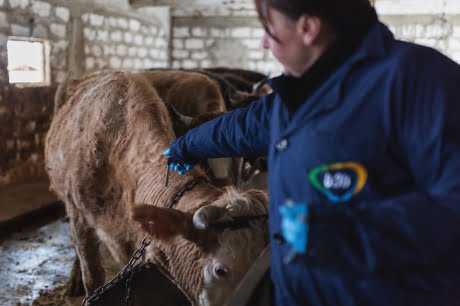
Located in Tare Sector, the market specializes in livestock trading, including cows, pigs, goats, and sheep, and serves residents of Nyamagabe as well as refugees living at the Kigeme camp. Traders say the upgraded facility has improved security, allowing merchants to operate without worrying about the safety of their money and goods.
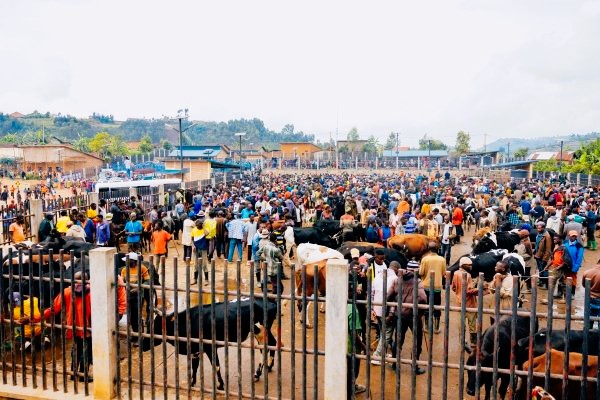
The market has three main sections designated for sheep, goats, pigs, and cattle, and also includes a nursery for children. It was renovated under the “Jya Mbere” (Go Forward) Project implemented by the Ministry of Emergency Management (MINEMA).
According to project implementers, the renovation has addressed several long-standing challenges, particularly insecurity and poor trading conditions that previously affected livestock traders.
Liliane Ingabire, a pig farmer from Gasaka Sector and a long-time market trader, said the facility has significantly improved safety, noting that livestock theft was common before the renovation. “Before the market, it was chaos. One day, an animal bit me on the leg. I felt helpless. But that doesn’t happen anymore, thanks to this market, which has solved many problems, including this chaos. Living here wasn’t easy.”
For refugees living in the Kigeme camp, the market has also become an important source of income and a business opportunity.
Faustin Mugisha, a refugee who arrived at the camp in 2013 from the Democratic Republic of Congo, said the market enables them to engage in small-scale livestock trading.
“What’s useful for us, who live in the camp, is that when we have money, we come here to buy an animal. We buy it thin and let it graze and fatten up. Once it has gained some weight, we bring it back, resell it, and make a profit. For example, when I buy animals and sell them, I buy others, bring them back to graze, and once they have gained weight, I resell them,” she opined.
The increased activity at the market has also benefited businesses operating around the facility. Simon Mutangana, who runs a food stall outside the market, said the renovation has boosted customer traffic and improved his earnings.
“This has given the market international renown, as many people who need a place to rest come to us, give us money, and we offer them food. On market days, I can accommodate about 200 people and turn over around 200,000 Rwandan francs; on weekends, we earn around 80,000 Rwandan francs. We are grateful to the Rwandan government for rehabilitating this market. Even the livestock farmers have seen their incomes increase,” says Mutangana.
Nyamagabe District officials also report increased tax revenue since the market’s renovation. Leonidas Nsengiyumva, the district’s tax inspector, said improved infrastructure and security have helped reduce tax evasion while strengthening revenue collection.
“People can no longer evade taxes at will because the gate is in good condition. We have fixed times for the entry and exit of animals, which has strengthened security on both sides. Before, we earned two million Frw, but since the construction of the market, we earn 2.8 million, and sometimes even three million Frw,” he said.
Frank Ngonga, Director of the Jya Mbere Project, said the decision to renovate the market followed concerns about the poor condition of the previous facility.
“The works cost more than 426 million Frw. Each animal has its own enclosure, and other people can now sell other items or clothes. This market also has a nursery: parents who come to the market with their children have reserved rooms with supervisors, and the district provides meals for the children when their parents come to set up their stall,” he notes.
Today, the Ryarubondo market attracts more than 3,000 traders and buyers from districts including Nyamagabe, Huye, Nyanza, Nyaruguru, Ruhango, and Rusizi, as well as visitors from neighbouring countries such as the Democratic Republic of Congo and Uganda.
The market occupies half a hectare and operates every Tuesday, drawing between 3,000 and 4,000 people on market days. Livestock trading is significant, with 800 to 1,000 cows, about 800 pigs, and around 500 goats and sheep sold during each market day.