
By Henry Kinyua
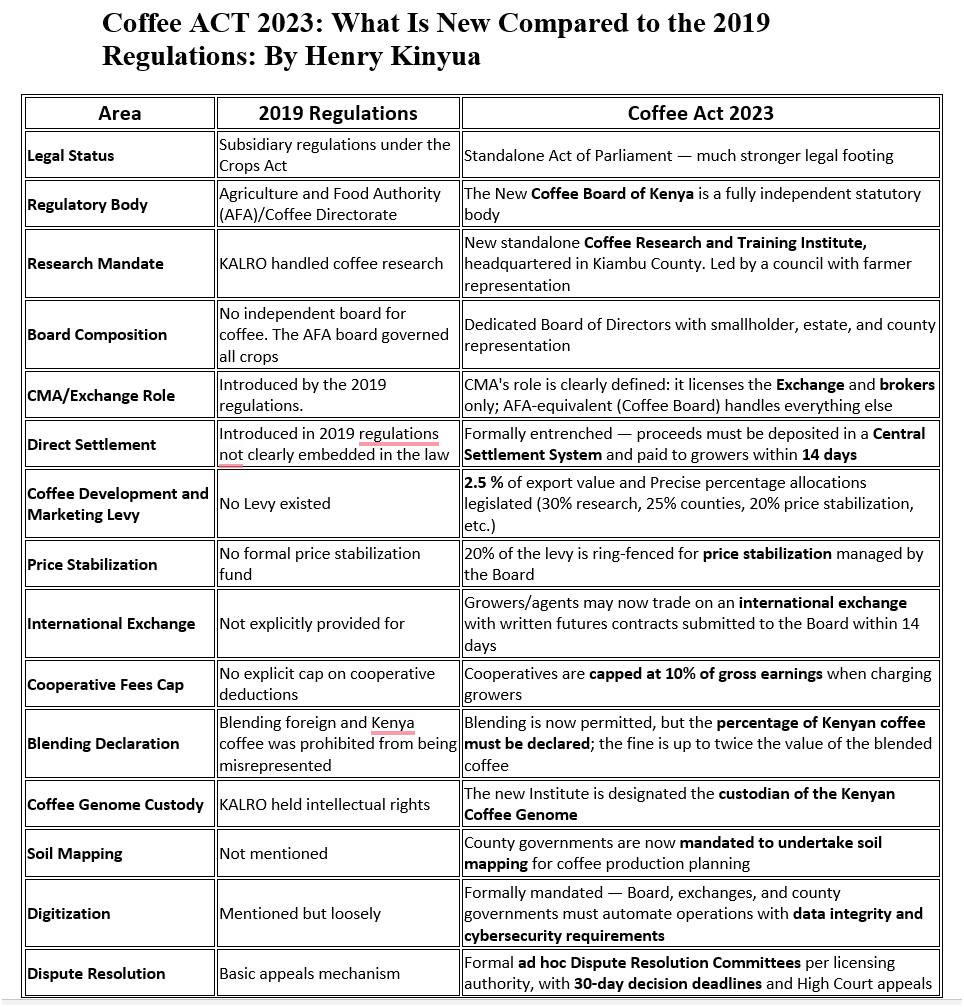
If laws were coffee varieties, the Coffee Act 2023 would be the sector’s new high-yield hybrid designed to fix weaknesses of the past while improving productivity across the entire value chain. Recently assented into law, the Act represents the most comprehensive legal overhaul of Kenya’s coffee sector in decades, replacing the previous framework that relied on subsidiary regulations under the Crops Act of 2013.
Under the earlier system, coffee was governed largely through Legal Notice 102 of 2019, administered by the Agriculture and Food Authority (AFA) through the Coffee Directorate. The new law elevates coffee governance into a standalone Act of Parliament, consolidating regulation of production, marketing, research, finance, and dispute resolution into one comprehensive framework structured across twelve Parts.
One of the most significant reforms is the creation of two independent statutory institutions dedicated exclusively to coffee. The Coffee Board of Kenya replaces the AFA Coffee Directorate as the sector’s primary regulator, giving coffee its own dedicated oversight body rather than sharing governance with multiple crops.
The Board operates as a full corporate entity with its own board of directors, chief executive officer, budget, and audit responsibilities. Alongside it, the Act establishes the Coffee Research and Training Institute, which takes over the coffee research mandate previously held within the Kenya Agricultural and Livestock Research Organization (KALRO). The institute will oversee research, training, and the protection of Kenya’s coffee genetic resources, including custody of the national coffee genome.
The Act also simplifies Kenya’s licensing structure. The Second Schedule lists 17 licences and permits, clearly allocated among the Coffee Board, county governments, and the Capital Markets Authority (CMA).
Coffee trading pathways are also expanded. The law formally recognizes four marketing channels:
• Auction trading through a licensed exchange
• Direct sales between growers and buyers
• Trading through international exchanges
• Any additional mechanisms that may be approved by the Cabinet Secretary
This flexibility reflects the evolving nature of global coffee markets while preserving regulatory oversight.
To support long-term development of the sector, the Act introduces a 2.5% levy on the export or import value of coffee. The funds are distributed through a structured formula designed to address key sector priorities:
• 30% – Coffee Research and Training Institute
• 25% – County governments in coffee-growing areas
• 20% – Price Stabilization Fund
• 15% – Coffee Board regulation and oversight
• 10% – Coffee marketing and promotion
This marks the first time Kenya’s coffee industry has a legally defined funding mechanism dedicated to research, market development, and price stabilization.
The Act formally entrenches the Direct Settlement System, requiring coffee proceeds to pass through a Central Settlement System before being paid to growers within 14 days.
In addition, the law introduces a 10% cap on cooperative deductions, placing a legal ceiling on the charges that cooperatives may impose on farmer earnings. A Price Stabilization Fund, financed through the levy, is also created to cushion farmers during periods of volatile international prices.
The Act introduces a structured dispute resolution system by requiring each licensing authority to establish an ad hoc Dispute Resolution Committee. These committees must make determinations within 30 days, with appeals directed to the High Court. This provision aims to resolve sector disputes faster and reduce costly legal delays.
Taken together, the Coffee Act 2025 represents a generational shift in the governance of Kenya’s coffee sector. By establishing dedicated institutions, strengthening research, introducing predictable sector financing, and protecting farmer incomes through payment safeguards and cooperative caps, the law directly tackles many of the structural challenges that have troubled growers for decades. In simple terms, the reform signals that Kenya’s coffee industry is no longer running on borrowed legal frameworks. It now has its own dedicated engine, one designed to keep the country’s famous beans competitive in global markets while ensuring the farmers who grow them receive a fairer share of the value.
And if the reforms work as intended, the next time Kenyan coffee travels the world, whether through auctions, direct sales, or international exchanges, it will carry not just its famous flavour, but also a stronger system behind every bean.
The next step is developing regulations and gazette notices from the CS to operationalize the ACT, and I hope farmers will be represented in every step.