By Henry Kinyua
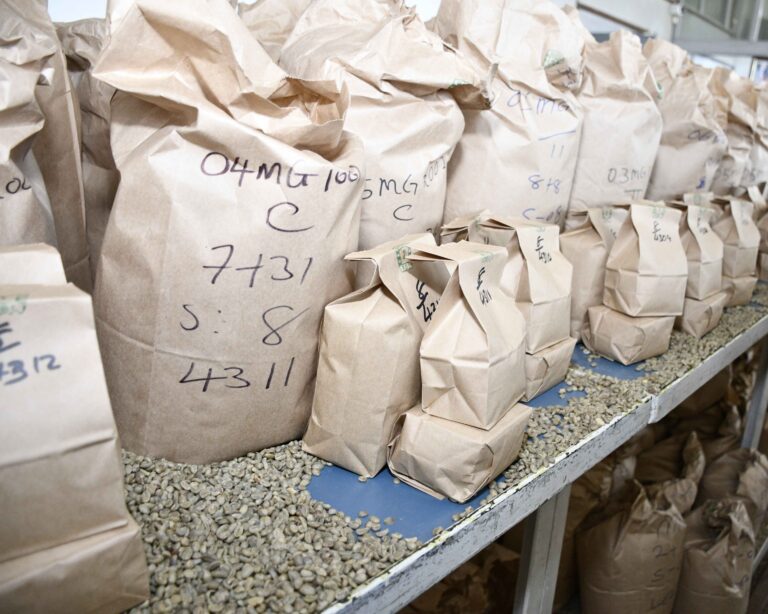
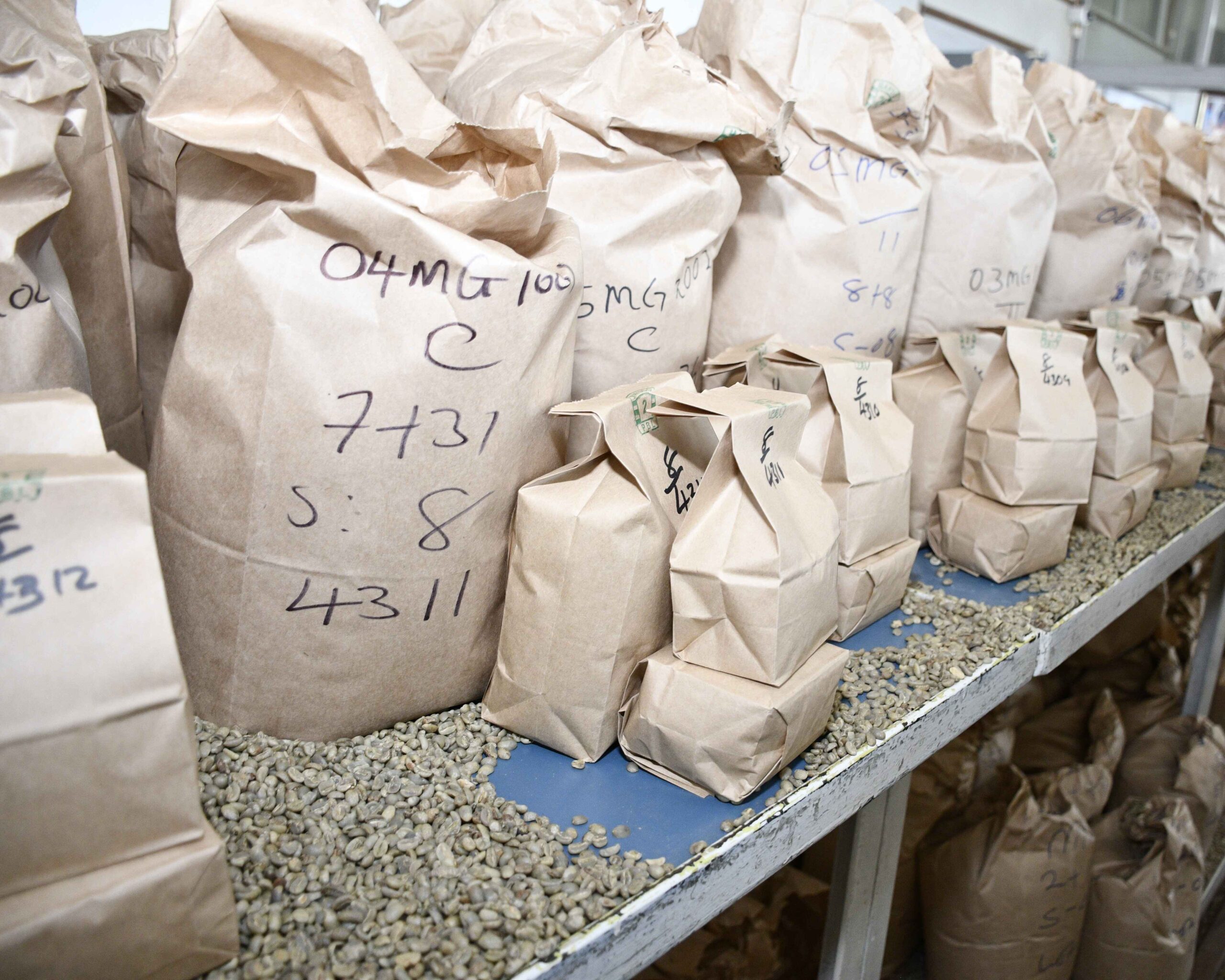
If coffee bags could talk, the certified ones at Sale 17 would probably stride into the Nairobi Coffee Exchange wearing tailored suits, briefcases in hand, announcing: “Excuse me, I come with documentation.” In today’s export market, that paperwork matters almost as much as the flavour.
The numbers tell a compelling story. At Sale 17, certified coffee didn’t just participate; it dominated.
A total of 12,023 bags (733,284 kilograms) carrying sustainability credentials changed hands, generating USD 4,983,792 at an average price of USD 340 per 50kg bag. That’s USD 19 more per bag than the overall sale average of USD 321. Do the math: certified lots represented 39% of total volume but likely contributed nearly half the auction’s total value. In a market where buyers are increasingly selective, certification provided a measurable price cushion that ordinary coffee simply couldn’t command.
Certification in coffee functions as third-party assurance that beans were produced under defined standards covering sustainability, environmental protection, labour conditions, and increasingly, traceability requirements like the EU Deforestation Regulation (EUDR) compliance. For buyers navigating tightening global regulations and brand reputation risks, certification reduces uncertainty. For farmers, it translates into better market access and, as Sale 17 demonstrates, stronger prices.
But here’s where it gets interesting: the certified segment wasn’t just bigger, it was more sophisticated. Rainforest Alliance (RA) dominated the certified lots, appearing either alone or combined with other schemes, reflecting strong global demand for sustainability-verified coffee.
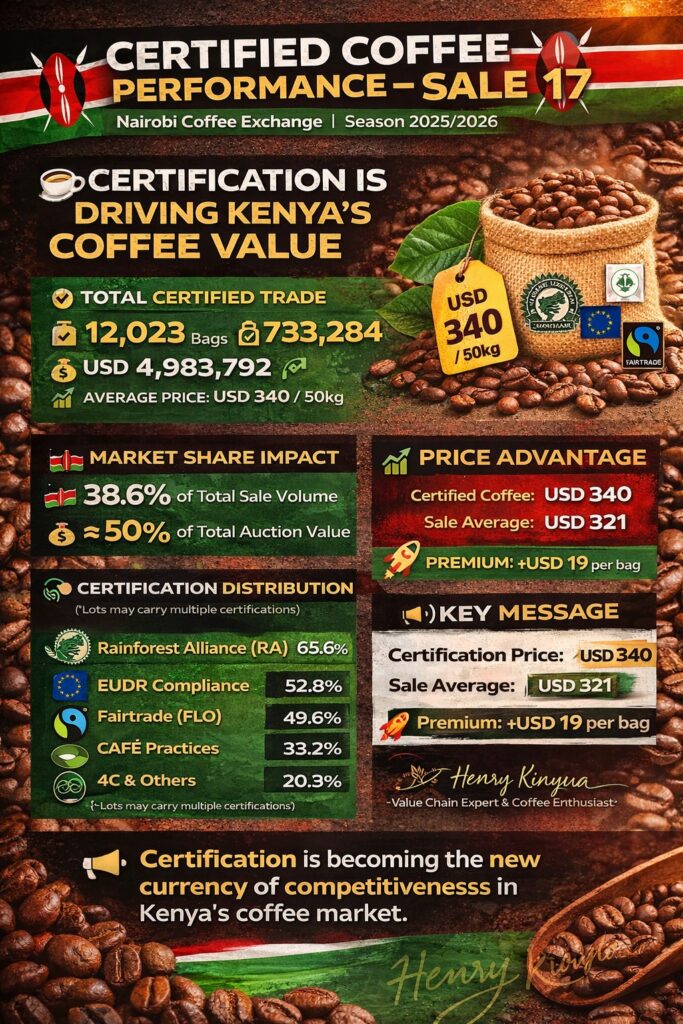
EUDR-aligned traceability certifications formed the next largest category, underscoring how European compliance requirements are fundamentally reshaping Kenyan coffee marketing. Fairtrade (FLO) also featured prominently, often paired with other certifications, while CAFÉ Practices and 4C appeared in smaller but meaningful volumes.
The pattern emerging from Sale 17 is clear: the market is shifting from single labels toward stacked credentials. Many lots carried multiple certifications simultaneously, a coffee might be both Rainforest Alliance certified and EUDR-compliant, sometimes with Fairtrade verification layered on top. Buyers are rewarding coffees that meet both sustainability expectations and regulatory compliance requirements at once. It’s no longer enough to be “sustainable” or “traceable”; the premium goes to coffee that can prove it’s both, preferably with internationally recognized stamps of approval.
Sale 17 delivered a straightforward message to Kenyan producers and cooperatives: quality still matters, but verified quality matters more. Certification is rapidly becoming part of the competitive toolkit, not an optional add-on for niche markets.
The implications extend beyond pricing. As European markets tighten traceability requirements and global buyers face mounting pressure to demonstrate supply chain responsibility, uncertified coffee may find itself not just receiving lower prices but struggling to find buyers at all. For cooperatives and estates still operating without certification, Sale 17’s results should serve as a wake-up call. The investment in certification processes, from record-keeping systems to compliance training, is increasingly becoming a prerequisite for accessing premium markets rather than a value-add feature.
If this trend continues, and all market indicators suggest it will, future auction catalogues may start resembling academic CVs more than coffee lists: full of credentials, endorsements, and verifiable achievements. The only difference? Instead of a graduation ceremony, the reward here is a measurable price premium per bag.
The certified coffee revolution isn’t coming to Kenya’s auction floor. Sale 17 proved it’s already here and has been for a while, and it’s rewriting the rules of competitive advantage, one documented bag at a time.