
By Kimuri Mwangi
Kenya’s tea industry demonstrated resilience in 2025, posting modest growth in earnings despite a complex mix of global economic pressures, declining production, and softer prices, according to the latest Tea Board of Kenya (TBK) performance report.
Total marketed value of tea rose by 2 percent to KSh 218.79 billion in 2025, up from KSh 215.21 billion in 2024 and KSh 196.97 billion in 2023. Export earnings remained the dominant driver, contributing KSh 186.91 billion, while local sales and committed stocks accounted for KSh 19.13 billion and KSh 12.75 billion, respectively.
This growth came despite a stronger Kenyan shilling, weaker global tea prices, and broader economic disruptions, including internal conflicts in key markets. Export volumes surged by 9.81 percent to 652.8 million kilogrammes, largely supported by carryover stocks from previous years.#
However, gains in volume were partially offset by declining unit prices and exchange rate effects. The average export price slipped to USD 2.21 per kilogramme from USD 2.27 in 2024, while the mean exchange rate weakened to KSh 129.50 per dollar from 134.82.
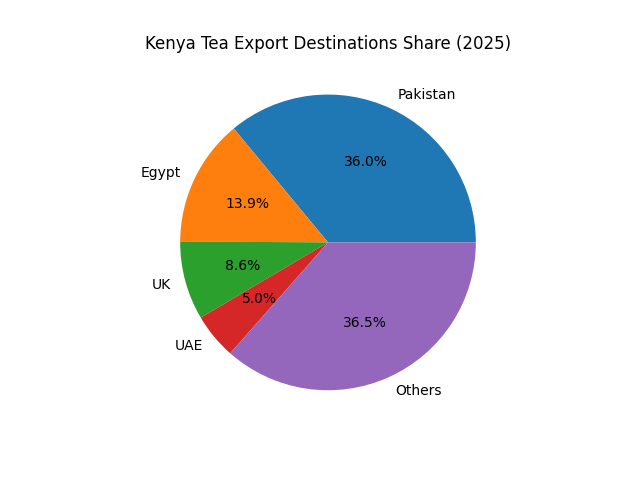
Kenya exported tea to 100 destinations in 2025, up from 96 in 2024, underscoring continued market diversification. Pakistan retained its position as the leading destination, absorbing 36 per cent of total exports, valued at KSh 73.41 billion, with 235.13 million kilogrammes.
Other key markets included Egypt (13.9 percent), the United Kingdom (8.6 percent), the United Arab Emirates (5 percent), and Russia (4.2 percent). The top ten destinations collectively accounted for 81.5 percent of export volumes, reflecting the continued dominance of traditional markets.
Growth trends varied across markets. Pakistan, Kazakhstan, and Oman recorded significant increases, driven by policy support, shifting consumer preferences, and regional trade dynamics. Kazakhstan’s imports grew sharply by 186.92 percent, while Oman expanded by over 320 percent, emerging as a key re-export hub for the Gulf region.
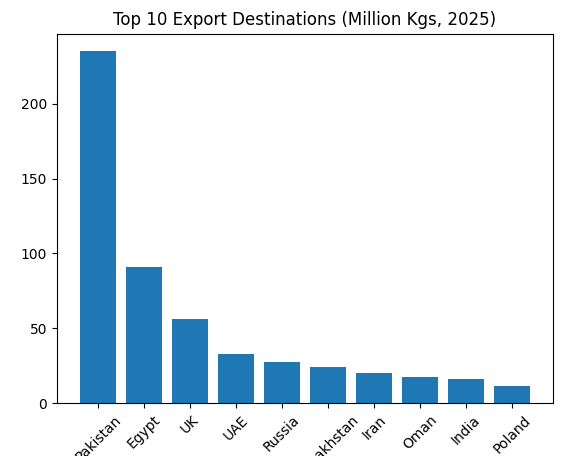
At the same time, exports declined in some markets, including the UK, Russia, India, and Poland, largely due to socio-economic challenges. Disruptions in Sudan and along the Red Sea shipping corridor also constrained trade flows, increasing transport costs and transit times.
Beyond traditional buyers, several non-traditional markets posted strong growth. Ireland, Japan, Jordan, Switzerland, and Malaysia all recorded notable increases, while Chad and South Sudan emerged as new growth frontiers due to shifting regional trade routes and supply chain adjustments.
The report highlights how geopolitical developments, such as conflict in Sudan, reshaped trade patterns, forcing landlocked countries like Chad to establish alternative import channels.
Value-added tea exports reached 25.36 million kilogrammes, representing just 4 percent of total exports. The United Kingdom led in this segment with a 32.4 percent share, followed by Sudan, Oman, and Somalia.
Policy interventions, including VAT removal on teas for value addition, supported this segment. The government is also pursuing the establishment of common user facilities, warehousing infrastructure in key markets, and a tea trade centre in China to strengthen downstream value chains and improve market access.
Local tea sales declined slightly in volume to 36.78 million kilogrammes from 37.50 million in 2024. However, revenues rose to KSh 19.13 billion, indicating improved pricing or product mix.
To stimulate domestic consumption, the government introduced tax incentives, including VAT exemption on tea and zero-rating of packaging materials, alongside a 25 percent excise duty on imported tea.
In contrast to the gains in earnings, tea production fell by 8.04 percent to 550.37 million kilogrammes, down from 598.47 million in 2024. The decline was attributed to erratic and poorly distributed rainfall.
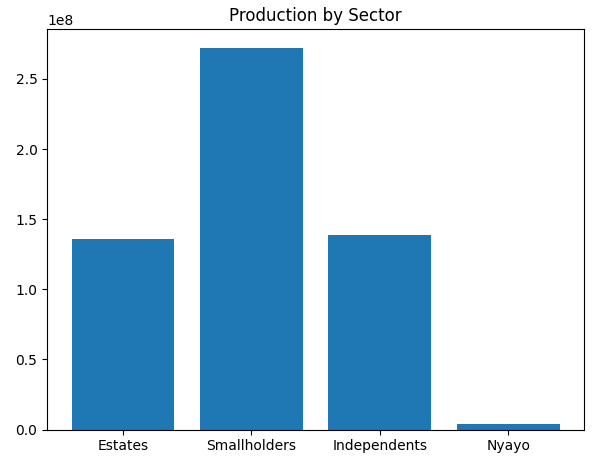
Smallholder farmers, particularly those under KTDA, recorded the steepest drop of 13.17 percent, highlighting their vulnerability to climate variability. Estate production declined by 5.72 percent, while independent producers posted marginal growth of 1.61 percent.
Specialty tea production remained minimal at 2.82 percent of total output, dominated by black orthodox teas.
The tea auction registered a significant improvement in absorption rate, rising to 73 percent from 55 percent in 2024, driven by reduced supply and stronger demand.
Despite this, average auction prices declined slightly to USD 2.15 per kilogramme from USD 2.19 in 2024, reflecting broader price pressures.
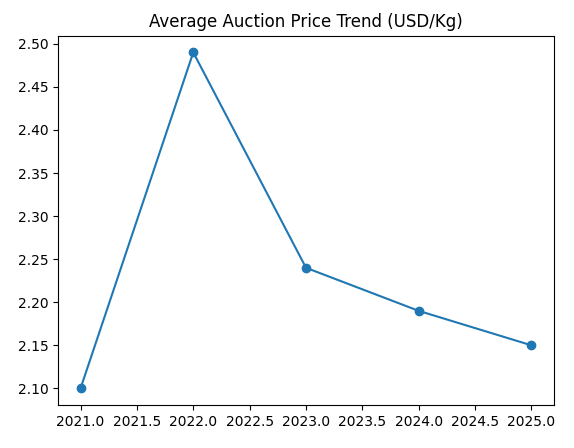
Quality remained a key determinant of price, with higher-grade teas from smallholder factories fetching up to USD 2.48 per kilogramme.
The introduction of a dedicated auction for orthodox and specialty teas in September marked a notable shift. These teas commanded higher prices ranging between USD 3.20 and USD 3.41 per kilogramme, signalling potential for diversification away from conventional CTC teas.
The 2025 performance underscores the Kenyan tea sector’s resilience, anchored by strong export demand and expanding market reach. However, the report also highlights structural vulnerabilities, including overreliance on traditional markets, limited value addition, exposure to climate shocks, and sensitivity to global price and currency fluctuations.
Efforts to diversify products, expand emerging markets, and strengthen value addition infrastructure are likely to shape the sector’s trajectory, as stakeholders seek to enhance competitiveness and stabilize earnings in an increasingly volatile global environment.