
By Henry Kinyua
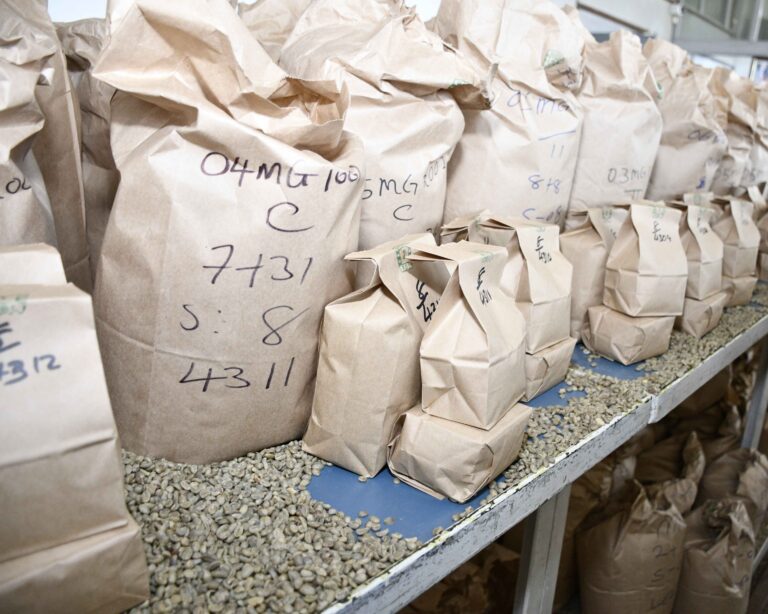
If coffee auctions had personalities, the Nairobi Coffee Exchange would probably be that calm trader who speaks quietly but moves millions before lunch. Sale 21 held on 10 March 2026 proved exactly that.
A total of 30,824 bags (1,887,393 kilograms) of clean coffee were traded with a market value of USD 11,604,039.52, equivalent to roughly KSh 1.51 billion circulating through the coffee economy in a single day. The auction achieved an average price of USD 307.41 per 50-kg bag, translating to about USD 6.15 per kilogram of clean coffee or roughly USD 0.9 per kilogram of cherry equivalent (around KSh 122 per kg of cherry using the typical 6:5 conversion). Compared with Sale 20, which traded 31,568 bags at an average price of USD 296, the latest sale recorded a slight drop in volume of 744 bags (-2.4%) but stronger prices, rising by USD 11.41 per bag (+4%).
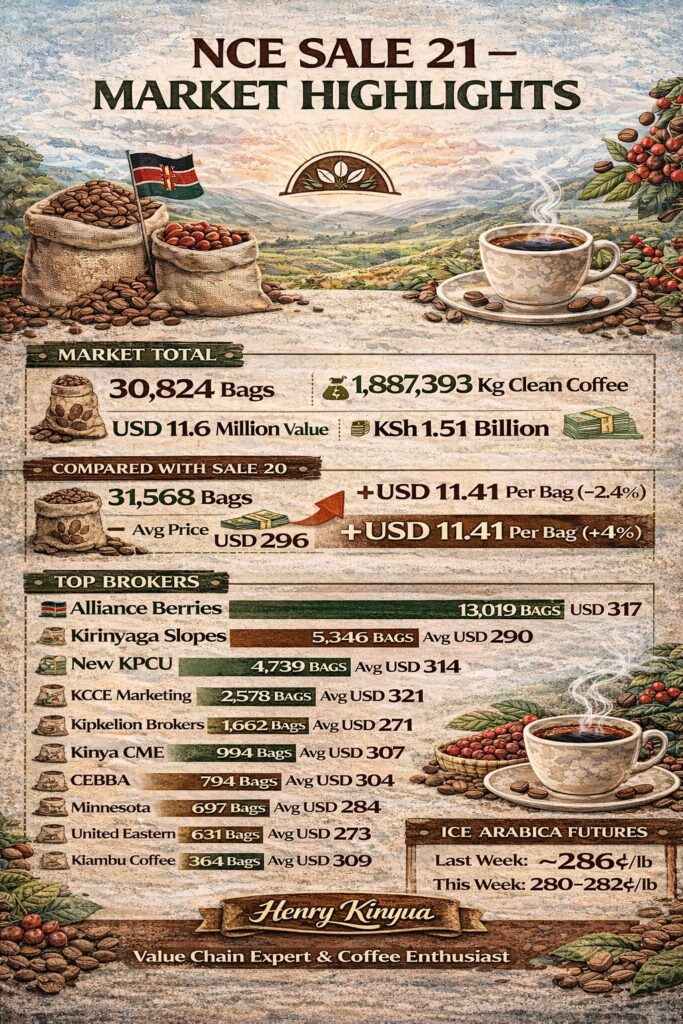
Broker performance again reflected the concentration of volumes among a few dominant marketing agents. Alliance Berries Limited led the market with 13,019 bags averaging USD 317per bag, followed by Kirinyaga Slopes Coffee Brokerage with 5,346 bags at USD 290, and New KPCU PLC with 4,739 bags averaging USD 314. KCCE Marketing Agency traded 2,578 bags at USD 321, while Kipkelion Broker Company offered 1,662 bags at USD 271, and Kinya Coffee Marketing Agency sold 994 bags, averaging USD 307.
Smaller offerings came from Coffee Estates Bourgeoisie Brokers (794 bags at USD 304), Minnesota Coffee Marketers (697 bags at USD 284), United Eastern Kenya Coffee Marketing Company (631 bags at USD 273) and Kiambu Coffee Marketing (364 bags averaging USD 309).
Interestingly, these firm Nairobi prices came even as the ICE New York Arabica futures market softened slightly during the week from about 286 cents per pound last week to roughly 280–282 cents per pound today, reinforcing a familiar truth in coffee markets: while global prices may wobble like a poorly balanced three-legged stool, Kenyan coffee often keeps its footing thanks to quality, reputation, and buyers who know a good cup when they taste one.